




WordPress Maintenance
How Often Should You Update WordPress Plugins, Themes, and Core?
WORDPRESS UPDATE GUIDE
How Often Should You Update WordPress Plugins, Themes, and Core?
Learn how frequently to review WordPress updates, which releases deserve immediate attention, and how to update your website without creating unnecessary risk.
Updated for 2026 · WordPress updates · Plugins and themes · Website maintenance
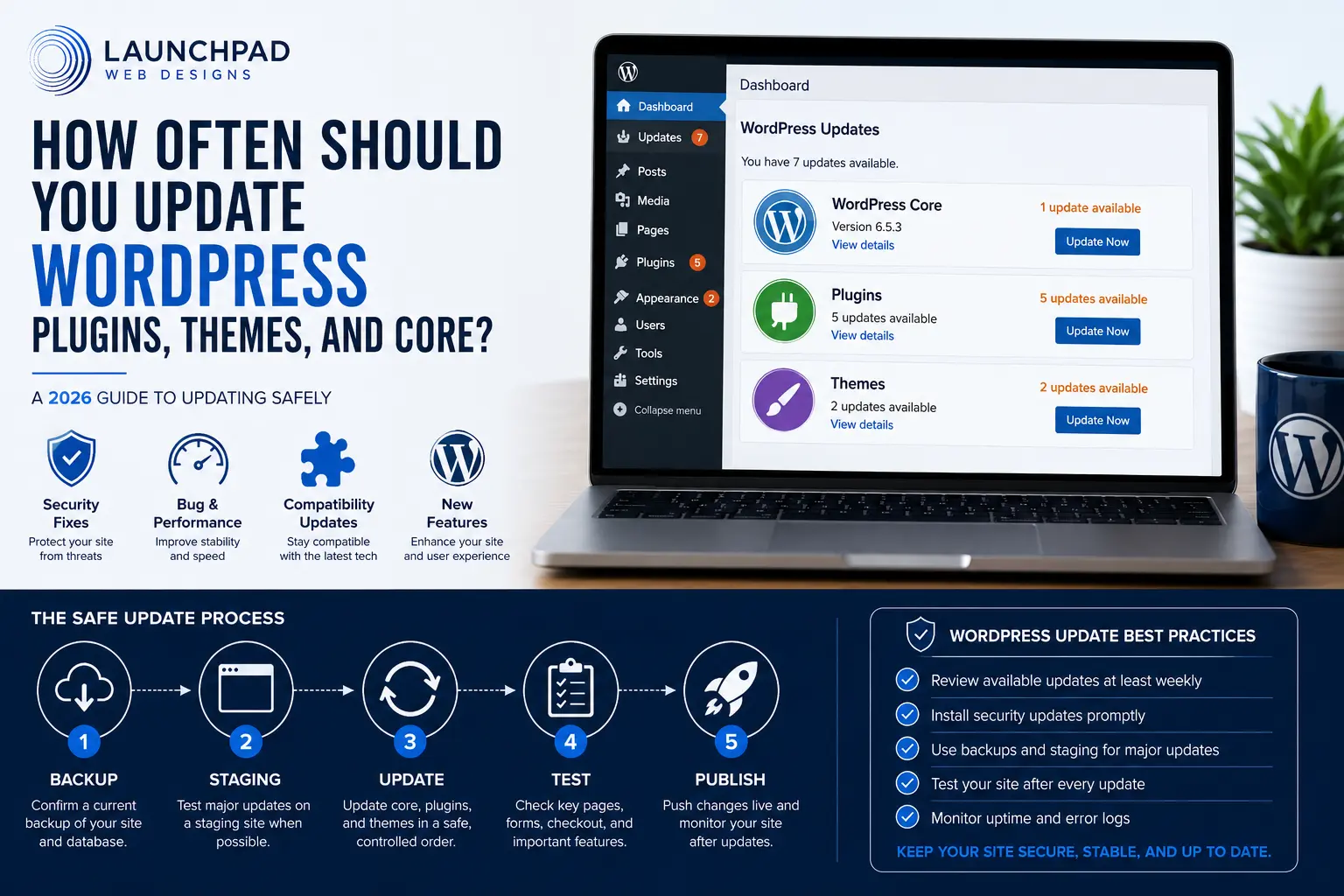
WordPress updates can contain security fixes, bug repairs, performance improvements, compatibility changes, and new features. Leaving software outdated for too long can expose the website to avoidable problems, but installing every update without preparation can also create conflicts.
There is no single waiting period that is appropriate for every update. A security release addressing an actively exploited vulnerability should be treated differently from an optional feature release that changes the plugin’s interface.
For most small-business websites, a practical starting point is to review available updates at least once per week, install urgent security fixes promptly, and complete routine tested updates on a scheduled weekly or monthly maintenance cycle.
Updates are one part of ongoing website care. See the complete WordPress Maintenance Checklist for 2026 for the backup, security, performance, content, and testing tasks that should accompany them.
In This Guide
View the article sections
Quick WordPress update recommendations
Why WordPress updates matter
Recommended update frequency
Updates that need prompt attention
How to update WordPress safely
Which WordPress components to update first
Should automatic updates be enabled?
When to use a staging website
What to test after updates
What to do when an update causes a problem
Outdated and abandoned plugins or themes
WooCommerce update considerations
Frequently asked questions
THE QUICK ANSWER
How often should WordPress be updated?
Review available WordPress core, plugin, and theme updates at least weekly. Install urgent security releases as soon as practical after confirming a current backup. Routine maintenance releases can usually be reviewed, backed up, installed, and tested during a scheduled weekly or monthly maintenance session.
SECURITY RELEASE
Install promptly
Prioritize updates that repair known vulnerabilities, especially when the issue is actively being exploited or affects a critical website component.
MAINTENANCE RELEASE
Review within days
Bug fixes and compatibility improvements should normally be installed during the next appropriate maintenance window.
MAJOR FEATURE RELEASE
Research and test first
Significant releases may introduce new features or compatibility changes and may deserve staging tests before installation on the live website.
WHY WORDPRESS UPDATES MATTER
Updates are about more than new features
Many updates repair issues that visitors may never see directly but that still affect the website’s security, stability, compatibility, and long-term reliability.
Security repairs
Updates may correct vulnerabilities that could otherwise be used to access, modify, disrupt, or misuse a website.
Bug fixes
Developers release updates to correct errors that can affect forms, layouts, payment processing, integrations, administration screens, or other functionality.
Compatibility improvements
Plugins and themes may need changes to remain compatible with current versions of WordPress, WooCommerce, PHP, browsers, and other connected software.
Performance and accessibility
Updates can improve efficiency, reduce errors, support current standards, and address usability or accessibility concerns.
Continued support
Developers may be unable to troubleshoot an outdated installation until the website has been moved to a currently supported version.
RECOMMENDED UPDATE FREQUENCY
Core, plugins, and themes require different decisions
The correct timing depends on what the update changes, how important the component is, whether a vulnerability is involved, and how easily the website can be tested and restored.
WORDPRESS CORE
Review every release
Security and maintenance releases generally deserve prompt installation after backups are confirmed.
Major releases may introduce broader changes. Review compatibility, release information, and the needs of important plugins and themes before updating.
PLUGINS
Review at least weekly
Security fixes should receive priority. Routine updates can be installed during a scheduled maintenance session after reviewing the change notes.
Complex plugins controlling ecommerce, memberships, forms, caching, security, or integrations may require additional testing.
THEMES
Review at least monthly
Install theme security and compatibility updates promptly after confirming that customizations are protected.
Sites using child themes or custom code should be checked carefully so updates do not overwrite or conflict with modifications.
WHEN NOT TO WAIT
Some WordPress updates need prompt attention
The presence of an update notification does not reveal its urgency. Review the release information and any security notices associated with the affected software.
□ A known vulnerability is being actively exploited.
Prompt action may reduce the window in which the website remains exposed.
□ The vulnerability can be exploited without authentication.
A flaw that does not require an attacker to log in may represent a broader exposure.
□ The affected plugin is active and publicly accessible.
A vulnerable feature that visitors can reach may deserve greater urgency than an inactive or restricted component.
□ The update repairs payment, account, or privacy-related functionality.
Problems affecting orders, customer accounts, sensitive data, or important integrations should be addressed carefully and quickly.
□ The developer or trusted security source recommends immediate action.
Follow the release guidance, which may include updating, disabling a feature, removing the software, or applying a temporary mitigation.
A SAFER WORDPRESS UPDATE PROCESS
Do more than click “Update All”
A repeatable process makes it easier to prevent problems, identify the source of a conflict, and restore the website when an update does not work as expected.
1. Review available updates
Identify whether the release is a security fix, maintenance update, major version, feature change, or compatibility release. Review change notes and known issues when available.
2. Confirm a current backup
Make sure the database and website files are protected and that the backup can be accessed if restoration becomes necessary.
3. Check compatibility
Consider the current versions of WordPress, PHP, the active theme, WooCommerce, and important plugins. Look for documented version requirements or known conflicts.
4. Use staging when appropriate
Test major or business-critical updates on a private copy of the website before installing them on the live site.
5. Update in manageable groups
Avoid installing a large collection of unrelated updates simultaneously. Smaller groups make it easier to identify which change introduced a problem.
6. Test the website afterward
Review the website’s appearance and test important functions. An update can complete successfully in the dashboard while still causing a front-end problem.
A dependable backup is essential before substantial updates. See How Often Should You Back Up Your WordPress Website? for guidance on backup frequency, retention, storage, and restoration testing.
UPDATE ORDER
Which WordPress component should be updated first?
There is no universal order for every website. Release instructions, dependencies, compatibility requirements, and the role of each component should guide the sequence.
1. Confirm the backup before changing anything.
A usable restore point should exist before the first update begins.
2. Read instructions for major or dependent products.
WooCommerce, membership systems, page builders, payment extensions, and other platforms may recommend a specific order.
3. Update related extensions thoughtfully.
An extension may require a newer version of its parent plugin, or the parent plugin may require extensions to be ready first.
4. Separate major updates from routine updates.
Do not combine several high-impact changes when testing each one individually would make troubleshooting easier.
5. Test after each important group.
Confirm that the website still works before moving to the next group of components.
WORDPRESS AUTOMATIC UPDATES
Should plugin and theme auto-updates be enabled?
Automatic updates can reduce the time a website remains on an outdated version, but they still require backups, monitoring, and functional checks. The best choice depends on the component’s risk and importance.
Auto-updates may be appropriate when:
✓ The plugin is simple and widely used
✓ Updates have historically been reliable
✓ The website has dependable backups
✓ Uptime and error monitoring are active
✓ Someone reviews update notifications
✓ Important functions are tested regularly
✓ The component is not heavily customized
Manual review may be safer when:
✓ The plugin controls payments or checkout
✓ The site uses memberships or subscriptions
✓ The theme contains custom modifications
✓ The update is a major version change
✓ Several components depend on one another
✓ Downtime would significantly affect the business
✓ Staging tests are needed before deployment
Important: Automatic installation does not mean automatic verification. Someone should still confirm that backups completed, review update notices, monitor the website, and test critical functions.
STAGING AND UPDATE TESTING
When should updates be tested on a staging website?
A staging site is a private copy of the website used to test changes without immediately affecting the public version. It is most useful when an update could influence several important systems.
□ Major WordPress core releases
□ Major page-builder or theme updates
□ WooCommerce and payment updates
□ Membership, booking, course, or subscription systems
□ Updates that modify the database
□ Components with extensive custom code
□ Several interdependent plugin updates
□ Websites where brief downtime would significantly affect the business
POST-UPDATE TESTING
What should you test after updating WordPress?
Test the functions that matter to the business rather than checking only whether the homepage loads.
□ Open the homepage and primary service or product pages
□ Review desktop, tablet, and mobile layouts
□ Test navigation menus, buttons, links, and search
□ Submit important contact and lead-generation forms
□ Confirm form notifications reach the correct inbox
□ Test account login, password reset, and restricted content
□ Review galleries, sliders, popups, accordions, and interactive elements
□ Test checkout, payments, coupons, shipping, taxes, and transactional emails
□ Check scheduling, CRM, email marketing, and other integrations
□ Review the browser console, PHP logs, and WordPress Site Health when appropriate
□ Clear or refresh relevant caches after confirming the update
WHEN AN UPDATE CAUSES A PROBLEM
Do not make a series of untracked changes
When an update affects the website, the priority is to protect the site, identify what changed, and choose the safest recovery path.
1. Document the problem.
Record the error message, affected page, recent update, time, device, browser, and steps needed to reproduce the issue.
2. Check whether the issue is cache-related.
Clear the appropriate website, server, browser, and CDN caches without deleting unrelated data.
3. Review logs and recovery notices.
PHP logs, WordPress recovery mode, plugin notices, and browser-console errors may help identify the affected component.
4. Avoid randomly disabling everything.
Use a controlled troubleshooting process so the original problem and each attempted change are documented.
5. Roll back or restore when appropriate.
A previous software version or full backup may provide temporary recovery, but the underlying compatibility or security concern still needs to be resolved.
6. Contact the appropriate developer or professional.
Provide the version numbers, logs, screenshots, and troubleshooting steps already completed.
OUTDATED AND ABANDONED SOFTWARE
What if a plugin or theme no longer receives updates?
The absence of an update notification does not prove that the software remains secure or compatible. The developer may have stopped maintaining it.
□ Check when the software was last updated
□ Review supported WordPress and PHP versions
□ Look for unresolved support reports or developer announcements
□ Determine whether an active license or account connection has expired
□ Review whether the component remains necessary
□ Identify a supported replacement when continued use presents a concern
□ Test the replacement carefully before removing the original component
WOOCOMMERCE UPDATES
Online stores require additional care
WooCommerce updates can affect products, orders, customer accounts, payment gateways, taxes, shipping, subscriptions, emails, templates, and the database. Test important store updates before changing the live website whenever practical.
Before updating
□ Confirm a current store backup
□ Review WooCommerce release information
□ Check theme and extension compatibility
□ Confirm payment-gateway readiness
□ Test the update on staging
□ Avoid peak sales periods
□ Document the recovery process
After updating
□ Review products and variations
□ Add and remove cart items
□ Test coupons and discounts
□ Confirm shipping and taxes
□ Complete a test payment
□ Verify order and customer emails
□ Review account and download access
Know which updates were completed and tested
LaunchPad’s monthly Website Care reports document completed software updates alongside backup status, security monitoring, uptime, performance checks, and support work.
See What a Monthly Report IncludesCOMMON WORDPRESS UPDATE MISTAKES
Updating safely requires a repeatable process
Common WordPress Update Mistakes
Waiting several months to review available updates
Allowing updates to accumulate can leave known issues unresolved and make the eventual maintenance session more complicated. Review available updates regularly, even when they are not installed immediately.
Updating without a current backup
An update can expose an existing compatibility problem or create a new one. Confirm that both the database and website files are protected before making substantial changes.
Installing every update simultaneously
Large update batches make it harder to identify the component responsible for a problem. Use manageable groups and test important functions between them.
Assuming a successful dashboard message means the website works
The update process can complete while a form, layout, payment method, integration, or mobile feature is broken. Test the website from the visitor’s perspective afterward.
Ignoring plugin and theme licenses
Expired or disconnected licenses may prevent access to updates, support, and compatibility information. Review licenses for every important premium component.
Editing a parent theme directly
A parent-theme update may overwrite direct modifications. Theme customizations should generally be handled through supported settings, a child theme, or another appropriate customization method.
Leaving unused software installed
Inactive plugins and themes still require attention and may become outdated. Remove unnecessary components after confirming that the website does not depend on them.
Enabling automatic updates without monitoring
Automatic updates still require current backups, notifications, uptime monitoring, error monitoring, and periodic functional testing.
FREQUENTLY ASKED QUESTIONS
WordPress update FAQs
WordPress Update FAQs
How often should I check for WordPress updates?
Review available WordPress core, plugin, and theme updates at least once per week. Business-critical or higher-risk websites may require more frequent monitoring, particularly when security alerts are available.
Should I install WordPress updates immediately?
Promptly review every update, but base the installation timing on its purpose and risk. Security releases may require immediate or rapid action. Major feature releases may deserve compatibility research, a current backup, and staging tests before installation.
How often should WordPress plugins be updated?
Review plugin updates at least weekly. Install important security fixes promptly after confirming a backup. Routine maintenance releases can normally be included in a scheduled weekly or monthly maintenance session, depending on the website’s risk and activity.
How often should a WordPress theme be updated?
Review theme updates at least monthly and prioritize security or compatibility releases. Confirm that customizations are stored safely in a child theme, supported settings, or another appropriate location before updating the parent theme.
Should I enable automatic plugin updates?
Automatic updates may be appropriate for stable, low-risk components when dependable backups and monitoring are in place. Manually review updates for complex plugins controlling ecommerce, payments, memberships, subscriptions, custom layouts, or other business-critical functions.
Should I back up WordPress before every update?
Confirm a current backup before installing important updates or groups of updates. The backup should include the database and website files and should be accessible if the website needs to be restored.
Do I need a staging site to update WordPress?
Not every small maintenance release requires staging. A staging site is especially useful for major WordPress releases, WooCommerce updates, page builders, themes with custom code, database changes, and websites where downtime would significantly affect the business.
What should I test after updating WordPress?
Test the homepage, important pages, mobile layout, navigation, forms, email notifications, account access, search, interactive elements, and connected services. Ecommerce websites should also test products, carts, checkout, payments, shipping, taxes, and transactional emails.
What happens if I do not update WordPress?
The website may remain exposed to known security problems, compatibility issues, software defects, and unsupported components. The risk generally increases as outdated versions accumulate and other parts of the website continue changing.
What should I do if a WordPress update breaks my website?
Document the problem, review logs and recovery notices, rule out caching issues, and identify the most recent change. Use a controlled rollback or backup restoration when appropriate, then investigate the underlying compatibility problem before attempting the update again.
CONTINUE THE WORDPRESS MAINTENANCE SERIES
Build a complete Website Care strategy
Learn how maintenance plans work, which recurring tasks are needed, and how often your website should be backed up.
View the Maintenance Checklist Read the WordPress Backup GuideONGOING WORDPRESS WEBSITE CARE
WordPress updates should be managed—not merely installed
LaunchPad Website Care combines managed WordPress updates with recurring backups, uptime monitoring, security checks, performance reviews, reporting, and direct support.
Explore Website Care
Compare LaunchPad’s recurring maintenance plans and choose the support level that fits your website.
View Website Care Plans