No products in the cart.
Online Presence
Do You Need a Website If You Have Social Media?
SMALL BUSINESS WEBSITE STRATEGY
Does Your Business Need a Website If You Have Social Media?
Yes—but that does not mean you should abandon social media. A strong website and active social channels serve different purposes.
Social media can help people discover, follow, and interact with your business. Your website gives you a central place you control for explaining what you offer, building trust, appearing in search, showcasing your work, and turning interest into inquiries or customers.
Updated for 2026
THE QUICK ANSWER
Why have a website when your business already has social media?
Because your website and your social accounts do different jobs.
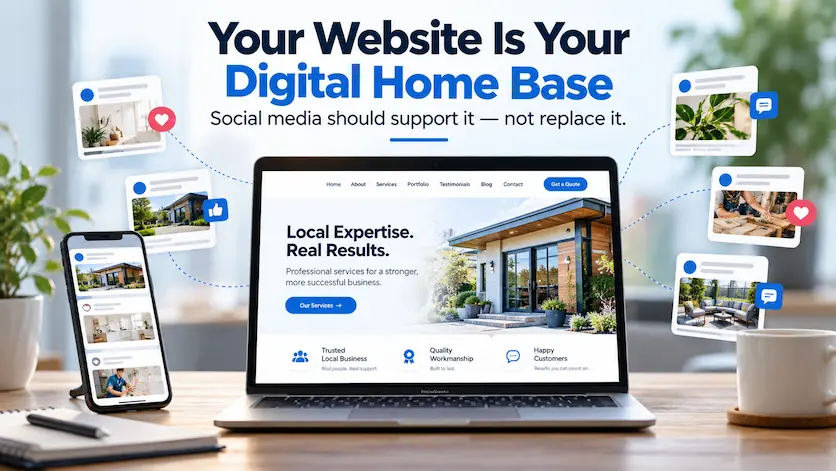
Your website is your digital home base. It gives you more control over your brand, content, navigation, calls to action, customer journey, search optimization, and business information. Your social accounts can then help distribute content, build familiarity, start conversations, and send interested people back to that home base.
The strongest strategy is usually not website versus social media. It is website plus social media, with each channel doing what it does best.
Website vs. social media at a glance
Your website:
Control · Search visibility · Detailed services · Portfolio · Lead capture · Long-term content
Social media:
Discovery · Conversation · Community · Familiarity · Sharing · Ongoing visibility
Best approach:
Use social channels to support and amplify a website you control.
In This Guide
1. Your website gives you more control
2. It gives customers a clear place to evaluate you
3. It creates a stronger search foundation
4. It can showcase your work and expertise in depth
5. It creates better conversion paths
6. It connects your online presence in one place
How your website and social media should work together
What a small-business website actually needs
Frequently asked questions
REASON 1
Your website gives you more control over your online presence
A social profile exists inside someone else’s platform. That platform determines the page layout, available features, account rules, feed behavior, advertising options, and much of the customer experience.
Your website gives you far more control over how your business is presented. You can organize services around the questions customers actually ask, create dedicated pages for important offers, show case studies, publish useful resources, build tailored contact paths, and change the experience as your business evolves.
This does not make social media unimportant. It simply means your entire online presence is less dependent on a platform you do not control.
WHAT YOU CONTROL
Your digital home base
✓ Your domain and site structure
✓ Your brand presentation
✓ Your services and offers
✓ Your calls to action
✓ Your portfolio and proof
✓ Your contact and lead pathways
✓ Your long-form content
✓ Your analytics and measurement
BUILD TRUST WITH CONTEXT
Give people enough information to evaluate you
✓ Clear services
✓ Real portfolio work
✓ Testimonials and reviews
✓ About information
✓ Credentials where relevant
✓ Pricing or pricing guidance
✓ FAQs
✓ Easy-to-find contact information
REASON 2
A website gives customers a clearer place to decide whether they trust you
Social profiles can absolutely help build credibility. Reviews, comments, posts, photos, videos, and an active presence can all make a business feel more real.
But prospective customers often need more information before they are ready to contact or buy from a business. A website gives you room to explain your services, approach, pricing, experience, process, policies, and past work without forcing visitors to piece the story together from individual posts.
This is particularly important for freelancers, consultants, contractors, healthcare professionals, and other service businesses where customers are evaluating the person or expertise behind the service.
LaunchPad’s client success stories are structured this way: not simply as screenshots, but as explanations of the problem, strategy, solution, and business purpose behind the work.
REASON 3
A website gives you a much stronger foundation for search visibility
Social profiles and social content can appear in Google, so it is no longer accurate to say that social media cannot contribute to search visibility.
The advantage of your own website is that you can build a deliberate search structure around the services, locations, questions, and topics that matter to your customers. Each useful page can have its own title, headings, internal links, supporting content, structured data, and conversion path.
Your official website can also become one of the sources search engines use to understand information about your business across search and local results.
SERVICE INTENT
Create pages for what you actually sell
A dedicated website lets individual services target distinct customer needs instead of squeezing every offer into a social profile bio or feed.
USEFUL CONTENT
Answer real customer questions
Guides, FAQs, comparisons, case studies, and educational articles can help prospective customers understand the subject before they contact you.
MEASUREMENT
See what actually produces business
Your site can connect search, referral, social, and conversion data so you can distinguish visibility from real inquiries and sales.
For a deeper look at the search side, read the WordPress SEO Guide, explore LaunchPad’s WordPress SEO services, or run the free WordPress SEO audit.
REASON 4
You can tell your story and showcase your work in much more depth
Social platforms intentionally standardize presentation. That consistency is useful for the platform, but it limits how much control an individual business has over its story.
Your website can reflect your own visual identity, voice, services, positioning, expertise, and customer journey. For a freelancer or creative professional, that may mean a strong portfolio. For a contractor, it may mean before-and-after projects. For a consultant, it may mean case studies and thought leadership. For a healthcare practice, it may mean provider information, treatment areas, FAQs, and appointment pathways.
The goal is not decoration. It is to give prospective customers the information and proof they need in a format that makes sense for your business.
Especially important for freelancers
A freelancer website can bring together:
✓ A clear niche or value proposition
✓ 3–6 strong portfolio examples
✓ Services and packages
✓ Testimonials or case studies
✓ About information
✓ Frequently asked questions
✓ Contact or booking options
BUILD THE NEXT STEP
A website can guide different visitors differently
✓ Request a quote
✓ Schedule an appointment
✓ Call the business
✓ Send an inquiry
✓ View services
✓ Compare pricing
✓ Browse a portfolio
✓ Buy a product
✓ Join an email list
REASON 5
Your website can create clearer conversion paths
Social media is excellent at generating awareness, conversation, and repeat exposure. But the next step after someone becomes interested is often easier to control on your own website.
A well-structured website can move someone naturally from a useful article to a relevant service, from a service to a case study, from a case study to pricing, and from there to an inquiry.
That is different from simply adding a “Contact Us” button everywhere. Good conversion design gives visitors the information they need before asking them to take action.
LaunchPad’s approach is built around this kind of connected journey across services, portfolio work, pricing, and the contact page.
REASON 6
Your website can connect everything else you do online
One of the most useful roles of a business website is simply organization.
Your social profiles, Google Business Profile, reviews, booking system, portfolio, services, resources, maps, ecommerce store, email signup, contact information, and other tools do not have to compete with one another. Your website can connect them into one logical experience.
That makes the website a hub rather than an isolated marketing channel.
ONE CENTRAL DESTINATION
Bring your business together
Social profiles → Website
Google Search → Website
Google Business Profile → Website
Email → Website
Referrals → Website
Directory profiles → Website
QR codes → Website
Ads → Website
DON’T CHOOSE ONE OR THE OTHER
How should your website and social media work together?
Think of social media as a group of useful roads and your website as the destination those roads can lead toward.
Your social content can introduce the business, demonstrate expertise, show recent work, share client stories, answer quick questions, and keep your brand familiar. When someone wants more detail, your website should make the next step easy.
DISCOVER
Social media starts the conversation
Share useful ideas, recent work, client wins, short educational content, and behind-the-scenes expertise.
EVALUATE
Your website provides the detail
Give visitors services, pricing guidance, proof, case studies, FAQs, About information, and resources in a structured format.
ACT
Your website creates the next step
Make it simple to contact, book, call, request an estimate, purchase, or take the most appropriate next action.
SOCIAL MEDIA STILL MATTERS
A website does not make social media unnecessary
The goal is not to pull your business away from Facebook, Instagram, TikTok, LinkedIn, Pinterest, YouTube, or whichever platforms genuinely reach your customers.
Social channels can be excellent for familiarity, interaction, visual storytelling, timely updates, community, referrals, and bringing personality to a brand. They can also appear within Google’s broader search and discovery ecosystem.
The mistake is relying on them as your only online presence when customers may also want a deeper, more organized source of information about your business.
KEEP IT PRACTICAL
What does a small-business website actually need?
You do not need a huge website simply because social media is not enough.
The right website should be large enough to explain the business clearly and support the actions customers need to take. For some freelancers or very small businesses, that may be a carefully designed one-page site. Others need separate service pages, portfolio work, ecommerce, booking functionality, location information, or educational content.
If you are starting from scratch, the upcoming refreshed guide on building your first business website walks through the planning process in detail.
CORE WEBSITE CHECKLIST
Start with the essentials
✓ Clear homepage message
✓ Services or products
✓ About information
✓ Trust and proof
✓ Contact path
✓ Mobile-friendly design
✓ Search-friendly structure
✓ Fast, secure hosting
✓ Analytics and measurement
Add only what the business actually needs.
A WEBSITE DOES NOT HAVE TO BE HUGE
Start at the right level
LaunchPad currently offers WordPress website options beginning with smaller freelancer and micro-business projects, with larger packages available as the business needs more pages and functionality.
WHAT ABOUT COST?
“I already have social media because a website feels too expensive or complicated.”
That is a reasonable concern. A website should support the business rather than become an expensive technical project for its own sake.
The right solution depends on what the business actually needs. A freelancer may only need a focused site that explains services, shows work, and captures inquiries. A growing service business may need several service pages, stronger local search structure, case studies, and ongoing Website Care.
Before choosing a platform or project size, decide what the website must help customers understand and do. Then build around that requirement rather than around a long list of features.
You can compare LaunchPad’s current WordPress website pricing and packages or review website design services to see how different project sizes are structured.
THE SIMPLE DECISION
When is social media alone probably not enough?
CUSTOMERS NEED MORE DETAIL
Your offer takes explaining
If customers regularly need information about services, process, pricing, qualifications, examples, or FAQs before contacting you, a website gives that information a permanent home.
SEARCH MATTERS
You want to build organic visibility
If customers search Google for your services, locations, or expertise, your own website gives you substantially more control over what pages and topics you build around that demand.
LEADS MATTER
You need a reliable inquiry path
If your business depends on quotes, appointments, consultations, bookings, or purchases, your website can create a clearer journey from interest to action.
COMMON QUESTIONS
Website vs. social media FAQs
Quick answers for business owners deciding whether Facebook, Instagram, LinkedIn, TikTok, or another platform can replace a dedicated website.
Do I really need a website if my business has Facebook or Instagram?
A website is usually worthwhile when customers need detailed information about your services, pricing, work, credentials, location, or contact process. Social media can support discovery and engagement, while your website gives that information a more structured home you control.
Can a Facebook or Instagram page show up in Google?
Yes. Social profiles and social content can appear in Google Search, so they can contribute to your overall visibility. A dedicated website still gives you substantially more control over your site’s structure, service pages, content, internal links, metadata, calls to action, and long-term search strategy.
Is a website better than social media for getting leads?
Neither channel is automatically better for every business. Social media can create awareness and conversations, while a website can provide more detailed information and more controlled conversion paths such as quote requests, bookings, purchases, phone calls, and contact forms. They often work best together.
What should a small-business website include?
At minimum, most business websites benefit from a clear explanation of what the business offers, information about the business or owner, services or products, trust signals such as reviews or portfolio work, and an easy contact or conversion path. The exact page count depends on the business.
Does a freelancer need a website if they use Upwork, Fiverr, or social media?
Not every freelancer needs a large website, but having an independent online presence can make it easier to present a portfolio, explain services, establish a personal brand, attract clients outside third-party platforms, and create a direct contact path.
Can a one-page website be enough for a small business?
Yes. A well-planned one-page website can be appropriate for a simple business or freelancer when the offer is easy to explain and there are only a few important actions. Businesses with multiple services, locations, strong SEO goals, ecommerce, or substantial educational content usually benefit from a larger structure.
Should my social media accounts link to my website?
Usually, yes. If the website is the main place where customers can understand your services, see proof, compare options, or contact you, linking social profiles and relevant posts back to the most useful website page creates a more connected customer journey.
Should my website link back to my social media profiles?
Yes when those profiles are active and useful to customers. Social links can help visitors see current work, ongoing updates, video content, reviews, or community activity. The goal is for the website and social channels to reinforce one another.
KEEP BUILDING YOUR ONLINE PRESENCE
Related LaunchPad website guides
GETTING STARTED
Building Your First Business Website
Plan the pages, content, structure, design, SEO, testing, and launch of a new business website.
WEBSITE STRATEGY
5 Common Website Mistakes
Fix problems with messaging, calls to action, proof, mobile experience, and SEO foundations.
SEO
WordPress SEO Guide
Understand the technical, content, internal-linking, and authority foundations of WordPress SEO.
FREELANCERS
Freelancer Website Design
See how LaunchPad approaches professional WordPress websites for independent professionals.
PROOF
Client Success Stories
Explore real website transformations across service businesses, healthcare, ecommerce, landscaping, travel, and more.
PRICING
WordPress Website Pricing
Compare LaunchPad’s current starting prices and project options for freelancers and small businesses.
BUILD A HOME BASE YOU CONTROL
Ready to move beyond a social-media-only presence?
LaunchPad builds strategic WordPress websites for freelancers and small businesses that want a professional place to explain what they do, show real proof, get found, and make it easier for the right people to take the next step.
